

Modes of transportation in Bangkok and across Thailand were a wonder to me when I arrived in southeast Asia for the first time in 1990. Sure, they had cars and trucks and motorcycles. While the cars were pretty much just different flavors of the same vehicles we had in the U.S., the trucks and motorcycles were eye-popping to me.
On average, the trucks were a lot smaller than the semis I was accustomed to seeing, but wow, did they have style! Brightly colored and many of them intricately painted – I think some of them even had tassels and lights hanging off of them, but that may be my memory playing tricks on me. Regardless, I remember wondering why someone would take the time to paint so many different colors on a truck that would then just get as beat up as so many of them were. It was like if you turned a clown into a truck and then pelted it with gravel for 15-20 years.
OK, that got a little dark, but hopefully you get my point. As beat up as those fancy-colored trucks were, they still made me smile. Maybe that’s the point.
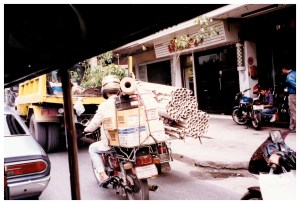
And then there were the motorcycles, which sometimes blurred the lines with trucks. I never knew a motorcycle could be a cargo vehicle until I saw the myriad ways that Thai people can strap a load of absolutely anything onto the back of a bike. The Thai aren’t alone in the world with that talent. Over the years, I’ve relished seeing various examples of this phenomenon around the world, and it still amazes me at how far the motorcycle-as-cargo-vehicle concept can be pushed.
A truck isn’t the only thing you can turn a motorcycle into, of course. You can also turn it into a minivan. Family of 5? No problem. Nursing or bottle feeding a baby? No problem!

The vehicle that I fell in love with in Thailand, though, was the tuk-tuk. Loud, often uncomfortable, frequently wildly decorated, and definitely dangerous, at least the way most of the tuk-tuk drivers hauled ass through the streets of Bangkok at the time. Or at least it felt dangerous. Looking back, I never remember seeing a tuk-tuk in an accident in Thailand or anywhere else I’ve had the pleasure of riding in them. I admit to being disappointed in the lack of thrills on the rides I took when returning to Thailand in 2015. There was simply too much traffic for them to get up a good head of steam.
Thailand in 1990 was also my first experience with public transportation in a developing country since that scary bus ride in Mexico City when I was 6. By the time I went to Thailand, however, I was prepared for the not-quite-fully-stopped experience of getting on and off the bus. It wasn’t just that part that reminded me I was in a foreign land, though. Even the simple act of buying a ticket was exotic.
The way it worked then was that you got on the bus, and then a guy would collect your fare as the bus continued on. Often, he would be at the opposite end of the bus from where you got on. As he would make his way to you, you could hear him clicking the door on the opening of his cylindrical metal change holder followed by a repeating pattern of paper being torn. Each ticket guy had their own rhythm, letting you know they were coming your way. The paper tears were the marks they would make on your ticket – a half tear on one side, a corner removed on the other. Each ticket got the same tears to show you had a current ticket rather than an old one. I assumed the pattern changed by the day but can’t be sure because I never saw the same ticket guy twice.
I didn’t take any buses the last time I was in Thailand, but I definitely didn’t see – or hear – any guys playing a change holder like a castanet on that big elevated rail line that zooms masses of people high above the traffic that they have now. That thing was way more efficient but a lot less charming.

 X Nomad Life