
OK, it’s time to talk food. I’m three weeks and one day into my stay in Medellín, which means I’m officially past the halfway mark of this trip, and I’ve yet to say much about the food. Let’s change that.
One thing that became obvious when I first started reading up on traditional Colombian cuisine is that they don’t do a lot of vegetables. It’s a very meat-centric diet if you don’t go seeking out veggies. Fortunately, that’s also pretty easy to do whether at a grocery store or a vegan restaurant. For this post, though, let’s keep it traditional.
Perhaps the most traditional dish of Colombia is the bandeja paisa (ban-DAY-ha PIE-sa), which you can easily find anywhere that serves typical Colombian food. It was the first meal I had when arriving in Medellín. It’s also such a giant plate of food that the two times I’ve eaten it, it’s been enough to keep me full through two meals. The full plate consists of white rice, beans, 1/2 a sweet plantain, chicharrón (pork rind), morcilla (black pudding), carne molida (ground beef), slice of avocado, a small arepa, and a fried egg on top. It’s a feast. Unable to finish my plate the first time I ordered this dish, I selected a variation the second time that only came with one meat – a pork steak – and french fries. I was no less full at the end of the meal, but at least no food was wasted, and it even came with a small salad of lettuce, tomato, and carrots. That won’t be my last time diving into one of these gut busters.

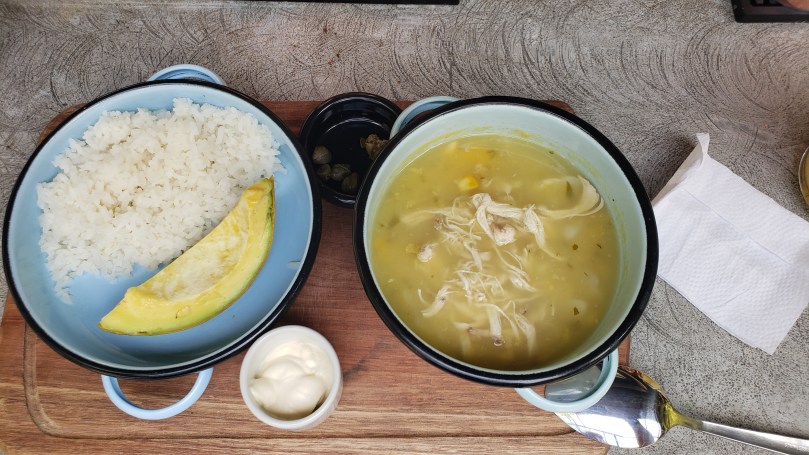
One of the nice things about staying at Selina is that they do a daily lunch special at the Garden Bar that is sometimes a traditional Colombian dish. These specials are usually tasty and always very affordable, especially if your frame of reference is the U.S. dollar, Euro, or Britsh pound. Recently, they served ajiaco santafereño (ah-jee-ah-ko san-tah-fer-ayn-yo). I had to Google how to eat it after they dropped off a couple of bowls and a couple of ramekins without any explanation. I’m glad I checked because I wouldn’t have gotten it right if I’d just guessed.
In one bowl is a stew of chicken, corn, and potatoes. The white rice in the second bowl gets dumped in the soup along with the thick cream in one of the ramekins and the capers in the other. Once that is all mixed up, you take a little bit of avocado on your spoon with each bite of stew. Delicious.
Chicken, both roasted and fried, is everywhere. On the mile stretch of road between Selina and the metro station at the bottom of the valley, there are at least 5 places I can think of where you can get either a full meal with sides or individual pieces of chicken for carryout. One of those is even a KFC for those into the global chain experience.
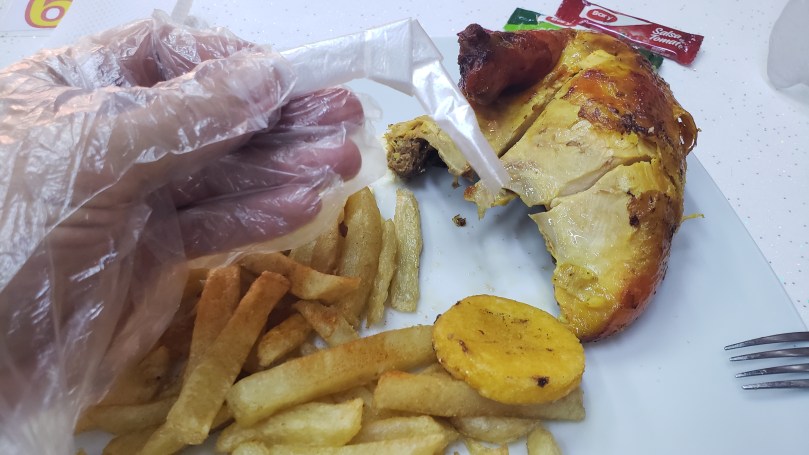
I like the local places, like Pollo al Carbon. The chicken is good, and it comes with fries, the most finely chopped coleslaw I’ve ever seen, and a patacón (pa-tah-CONE) that frankly I could do without. I find these twice fried plantain slices, also called tostones elsewhere in Latin America, dry and pretty bland. The chicken at Pollo al Carbon is good, but what I really like about the place are the plastic gloves they give you to eat your chicken without getting your hands greasy. They come folded up and tied in a little knot, and now every time I eat chicken without gloves on, I’m going to feel like a savage.
Last Thursday evening, I did a small walking tour of traditional Colombian food with My Favorite Paisa, a new company some friends I met at Selina are starting up. They are just getting going, but I think they will end up with a cool business offering some experiences off the beaten tourist path. I still need to do a write-up of their maiden voyage as a tour company that I went on. More on that later. This post is about food.
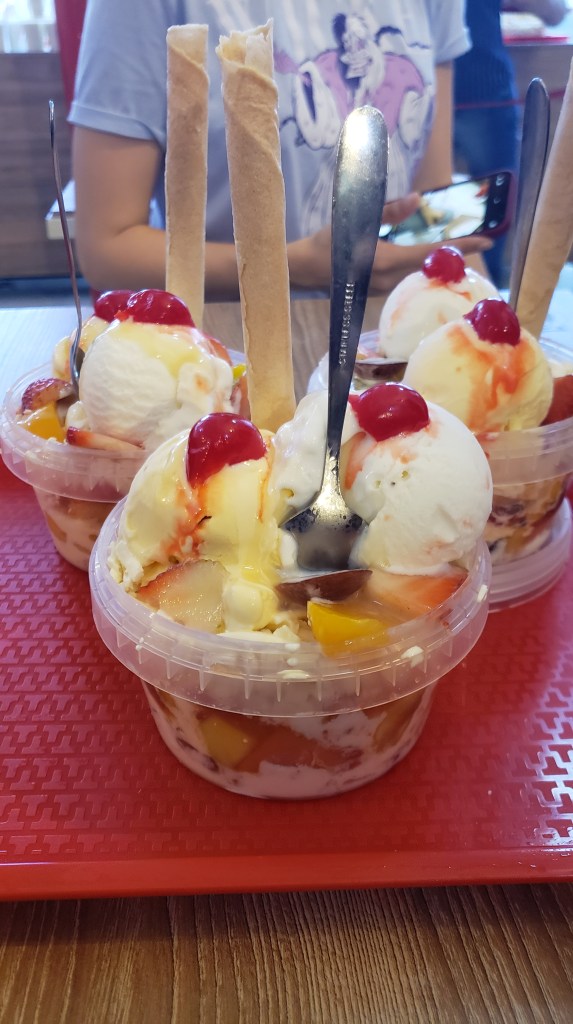
The first stop we made was at Ensaladas de Fruta to get a traditional Colombian fruit salad, which is often eaten as an after work snack prior to a much later dinner that starts around 8:30pm or later. What makes these fruit salads typically Colombian is that they have a lot more than fruit in them. The massive bowls that couples share have fruit in a base of sweetened condensed milk mixed with grated white cheese and topped with vanilla ice cream. And since that’s not enough, they come with a rolled up cookie.
It was made very clear to me: this is NOT a dessert. Don’t let the ice cream fool you. The portion shown in the photo below is the small size, and we were the only ones eating these. Everyone else was scooping from a salad bowl. I couldn’t finish mine, but my slender tour guide Vanessa had no issue powering through hers. I don’t think she was impressed with me giving up before getting to the end. Colombians aren’t messing around when it comes to fruit salad.
The second stop on the food tour was a place I’ll definitely go again, Las Empanadas de Soccoro. Empanadas are ubiquitous in Medellín. They make an easy snack or lunch if you want to get something quick and are available both at bakeries and at places that just sell empanadas. I’ve tried them at lots of different places, and the texture and flavor of the ones here were by far the best I’ve had.
The third stop was a bakery I didn’t remember to get the name of for some pandebono (pan-deh-boh-noh) and buñuelos (boon-yu-ay-los), traditional savory pastries. Pandebono varies in interior texture from bready to doughy. I much prefer the doughy kind, but maybe the bready kind will be more your speed. The point is, if you try them somewhere and think “meh,” it may be worth trying them again elsewhere to find your fit. When the doughy kind are good, they are really, really good! Wikipedia refers to buñuelos as a type of doughnut, but in Colombia they remind me more of the hushpuppies I grew up with in the southern U.S. Check out the picture of the Colombian version at the Wikipedia link above to see what I’m talking about.
One last item I’ll mention in this post is the arepa triple queso (ah-ray-pah trip-lay kay-soh), an arepa filled with cheese, then covered in cheese, then fried on the grill and topped with sweetened condensed milk. This one came from Las Chachas and cost US$1.25. So good. So decadent.

More to come at another time. Probably. I don’t have a specific Colombian food post part 2 planned. I’m just assuming there will be one.
P.S. I don’t get paid for the links in this post. They are there for your convenience.
 X Nomad Life
[…] breakfast. This is when I was first introduced to pandebonos and buñuelos that I wrote about in my last post. Our bellies full, we continued on to Salto del Buey to visit Los Saltos […]
LikeLike