
When I visited in Vietnam in 1990, I had traveled before. Extensively for someone my age. As a 21-year old in the summer before my senior year of college, I had already been to Mexico twice before the age of 10, but of course I was just along for the ride on those trips. My mother handled everything. Well, almost everything, but that’s a different story. At 17, I spent 6 weeks on my own in Europe, visiting England, Belgium, Germany, and France. Plus, I had already been in Thailand for a month when I landed in Saigon. In my mind, I was a world traveler who knew what he was doing.
Then I went to the currency exchange at the airport, not knowing as I do now that those places are about the worst choice you can make to get a good exchange rate. Just as you pay a premium for souvenirs at the airport, the exchange rates there are set to prey on travelers who have just arrived and are ignorant and desperate. Ignorant of the better rates and lower fees available once they get away from the airport and desperate for local currency to pay for a ride to their hotel. Most visitors are also ignorant of the prices that they can expect to pay for things so it is difficult to gauge how much money to change.
I’m not judging – myself or others. Dealing with expenses while away from your native country is difficult. Dare I say even sometimes a huge pain in the ass. More on that later…
Anyway, there I am, just off the plane in Saigon with plans to be in Vietnam for one week. Since I’d already been in Thailand for a month, I expected prices to be low and that my dollar would go a long way. Still, I expected to buy a train ticket to the north plus pay for my hotels so I broke out my American Express Traveler’s Checks – because that’s how you did it back then thanks to the protection they offered against loss or theft – and changed $100 into Vietnamese Dong.
1.6 million Vietnamese dong, to be precise. If I recall correctly, the largest bill they had at the time was a 1,000 dong note. I’d never held a brick of sixteen hundred bills before, tightly wrapped in rubber bands but still standing at least 6-inches high. I confess that there was something intoxicating about it. Intoxicating and terrifying. Nothing says “I’ve got wealth you can only dream of – please come rob me.” than holding a huge stack of bills in a place where one of those would buy several meals. I managed to get it hidden away but was still nervous in the taxi ride from the airport. I also managed not to spread it all out on the bed and roll around in it, but I’d be lying if I said I didn’t think about it.
Fast forward 33 years and 36 more countries visited, several of them multiple times. My best estimate is that I’ve traveled in countries outside of my native home in the U.S. at least 75 times. Over that time, the world has changed in many ways, and I’ve become much more adept at navigating international currency exchange, primarily through the use of a credit card for most transactions. Visa (not American Express, regardless of what the commercials say) is accepted virtually everywhere, and my Southwest Airlines Chase card offers not only a better rate than any currency exchange service but also no additional fees for international transactions. The $99 annual fee is more than worth it thanks to the benefits it offers including free rental car insurance, rebates on fees for line upgrades on Southwest if I find myself in the C boarding group, and more.
I’ve also learned that I get a much better exchange rate on cash by taking it out of a local ATM rather than traveling with US currency or dealing with traveler’s checks. Are those even a thing anymore?
A year ago, I would have said I had that part of travel all figured out. I would have been wrong. In my recent trips to Colombia and now Argentina, my international currency savviness has increased in two ways. I’ve learned about the existence of debit cards that offer a rebate on fees paid at international ATMs and about the Argentinian “blue dollar” exchange market although I’m still unclear on how the latter system works.
Two financial services firms in the U.S., Charles Schwab and Fidelity, offer checking accounts for their investor clients that rebate international ATM fees as part of the monthly statement. I’ve spoken with several travelers who have set up accounts at Charles Schwab with only a token amount of money on deposit in an investment account that has then allowed them to open an checking account to use while traveling. One reported that this approach only worked for a limited amount of time until Schwab figured out that they had no intention of actually using the investment account.
Since I actually do have investments at Fidelity, I intend to open a checking account there to take advantage of this currency exchange hack before I arrive in Mexico next month. Here in Argentina, such an account won’t do me any good because I’d have to be a fool to use an ATM here. That’s where the confusing blue dollar system comes in, so named because of the blue stripe on 100-dollar U.S. bills.
As of today, May 7, 2023, the official currency exchange rate for 1 U.S. dollar is 222.34 Argentinian pesos. That’s the rate you will get at a bank or from an ATM.
Using the blue dollar rate, on the other hand, I can get about 447.78 Argentinian pesos for each U.S. dollar, a little more than double than what a bank offers.
When I first heard about this difference from a friend in Colombia who had already visited Argentina, I assumed this was some sort of secret, black market trade conducted in the shadows. A back alley deal clandestinely made with shady-looking characters.
Nope. The rate I quoted above is directly from my receipt from Western Union for the $200 I transferred to myself from my U.S. account this morning for pick-up in Buenos Aires “immediately.” There are also non-bank currency exchange services everywhere that offer the same rate, with no additional fees added if you are traveling with U.S. $100-dollar bills. In addition, there are individuals in some parts of town offering to buy U.S. dollars using the blue dollar rate. While I have not exchanged money this way, this approach more closely matches what I expected when I first heard about it although I’m told it’s actually quite safe to change money this way.
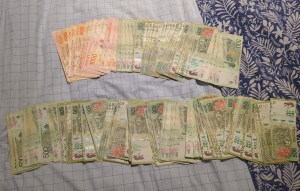
Changing money with individuals using an unofficial, not exactly legal but still tolerated practice makes sense to me given Argentina’s recent financial history. The people here have seen the value of the peso go up and down in such wild fluctuations that they simply don’t trust the peso. By converting their income into dollars, they offer themselves a level of protection again a monthly inflation rate approaching 10%.
What doesn’t make sense to me is that this service can be offered so openly at official, independent exchange houses. What is completely mind-boggling is that Western Union also offers this rate. How does that work? I haven’t done an exhaustive search on how they are able to get away with this but a quick search yielded no insight. It’s not that I don’t appreciate having this option. It’s just confusing to me how it works.
But beware – dealing with currency conversion in Argentina is still a pain in the ass, even with the seeming convenience of being able to transfer cash to yourself in minutes for pick-up at the nearest Western Union, with locations on seemingly every block. The problem is that EVERYONE is onto this option so there are two risks you have to deal with. One is that you can expect to stand in line, possibly for a long time, in order to make your desired withdrawal. Last Tuesday I managed to be fourth in line by arriving 30 minutes before they opened. Five minutes later, there were 15 people in line and 25 or so by the time they opened the doors at 9am.
The second problem is that they may not have any money. Today I was thrilled to find a location open on a Sunday that had only a couple of people in line. Unfortunately, the cash well had already run dry so they asked me to come back tomorrow.
You may think, “Well, I’ll just withdraw more money so I only have to deal with that hassle once.” You certainly have that option, but you also risk having a lot of money drawn at a lower rate than what is available a couple of weeks later. Four weeks after coming to Buenos Aires, I can now get 45 more pesos to the dollar than I could when I first got here. That’s only a dime, but dimes add up. If you’re going to be spending an extended time in Argentina, dealing with the hassle of currency exchange is something you’re probably going to have to plan for.
That said, credit cards are accepted most places. I was told that the rate you get on a credit card is somewhere between the official rate and the blue dollar rate, but a couple of spot checks on Uber suggest that may not actually be the case. At least through Uber, I got the blue dollar rate. Since I’m pretty much out of cash until tomorrow with plans to be out and about this afternoon, I’m probably going to get the chance to test that out at another location. Being able to use my Visa would definitely make things easier.
 X Nomad Life
[…] for a whopping total of $118.46 based on the current exchange rate on my credit card. If you read my last post, you know why that “on my credit card” is an important […]
LikeLike